

Tennis Australia (TA) has quietly launched pickleballaus.au — a move that signals what could be the biggest shake-up in Australian pickleball’s history. This isn’t just another website launch. It’s a clear statement of intent from one of Australia’s most powerful sporting bodies, coming just months after their successful Australian Open Pickleball Slam debut.
The immediate implications
The timing here is fascinating. While there’s been no formal announcement of the website’s launch, its discovery comes as Pickleball Australia (PA) has just cemented its position through a significant partnership with DUPR as their official rating system.
This alignment with DUPR could be seen as PA strengthening its foundations ahead of potential changes in the Australian pickleball landscape.
The domain name itself — pickleballaus.au — isn’t just a coincidence. You can copy my homework just change it up a little. Its similarity to PA’s existing pickleballaus.org domain sends a clear message about TA’s intentions in the space. With two major sporting bodies potentially vying for position in Australian pickleball’s future, we could be heading for some big changes.
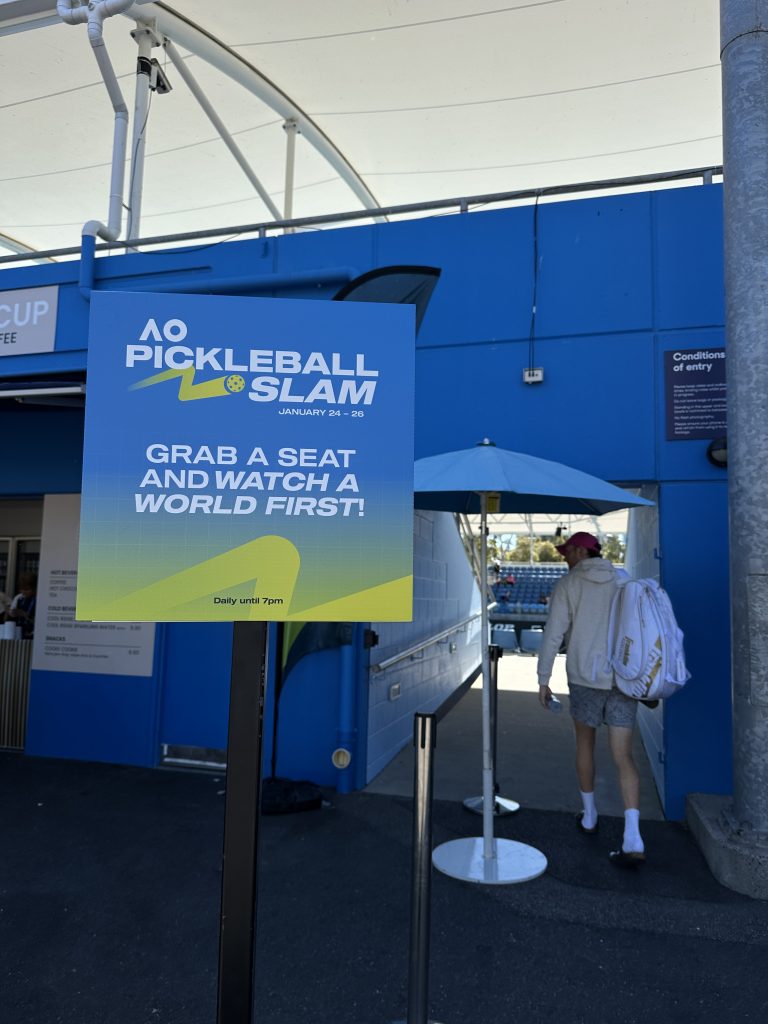
And for those who’ve been following along (if you haven’t, check out my AO Slam preview, Joey’s recap, and Tati’s take), we’ve been speculating about TA’s intentions in the pickleball space ever since their massive $100,000 prize pool tournament at the Australian Open in January.
At the time, I wrote about some predictions for the future of pickleball in Australia, and honestly… this feels like the first (or second?) domino falling.
Why this matters
The AO Slam showed us exactly what Tennis Australia can do. In just a few months, they:
- Organised a $104,000 prize pool tournament – the largest in Australian pickleball history
- Attracted thousands of spectators to Court 3 at Melbourne Park
- Generated substantial mainstream media coverage
- Delivered professional-grade broadcasts that drew thousands of YouTube viewers
When an organisation with this kind of reach and resources makes a move like this, the implications for pickleball’s future are significant.
The deeper scoop: What’s really going on here
The context
Let’s put this into perspective. Australian pickleball has seen explosive growth over the last few years, with Pickleball Australia’s most recent annual report stating over 90,000 players across Australia and 17,000 registered members as of early 2025. Until now — as the governing body of pickleball in Australia — PA has been steering this growth, building the sport from the ground up with limited resources.
The AO Slam in January marked Tennis Australia’s first major foray into pickleball, and they didn’t just dip their toes in — they made a splash. With minimal lead time, they:
- Secured prime-time media coverage, including breakfast news segments
- Delivered broadcast-quality livestreams
- Created a tournament environment that matched their professional tennis standards
- Drew in curious tennis fans who’d never seen pickleball before
This demonstrated capability gap between Tennis Australia and current pickleball organisations can’t be ignored. While Pickleball Australia has done remarkable work growing the sport, TA brings resources and reach that could rapidly accelerate pickleball’s development… for better or worse.
The power dynamics
The current pickleball landscape in Australia is complex, with relationships that aren’t always straightforward. Pickleball Australia has been navigating partnerships with major leagues, each with their own vision for the sport:
- The National Pickleball League (NPL) has maintained a degree of independence from PA
- PPA/MLP Australia has fostered closer ties with PA
- Now TA enters the picture with significant resources and established sporting infrastructure
The rating system situation adds another layer of complexity. Tennis Australia’s established partnership with Universal Tennis rating (UTR), which includes UTR-P for pickleball ratings, could have significant implications.
- Currently, all major Australian leagues (PPA/NPL) and Pickleball Australia are aligned with DUPR, with Pickleball Australia-sanctioned events now required to use this system
- If TA enters the space with UTR-P as their preferred system, it could create a complex situation for leagues and tournaments – particularly for any organisations considering alignment with TA
The US pickleball scene has already shown us how rating system divisions can impact the sport’s structure. Different tours use different systems – could we see a similar split develop in Australia?
What this means for everyone
Back in January through the AO slam preview, I wrote about the possibility of tennis and pickleball peacefully coexisting and the potential for more dedicated pickle courts. While this development adds complexity to that vision, it also validates the growing significance of pickleball in Australia’s sporting landscape.
Still, the implications of Tennis Australia popping into the pickleball scene could influence quite a bit in the space.
For venues and facilities —
- The tension between converting tennis courts and preserving them could intensify
- Tennis centres might fast-track pickleball integration with TA’s backing
- Existing pickleball venues could face competition or find new partnership opportunities
For players —
- Recreational players could get more access to facilities
- Professionals might see more tournaments and larger prize pools
- Both groups might face decisions about which body to support
For the future of pickleball —
- We could see more competing professional tours emerge
- The governance structure might fundamentally change
- Development pathways for new players and clubs could split
Looking ahead
This is arguably the most significant development in Australian pickleball’s young history. TA’s entry into the space could reshape everything from governance to competition structures. The key questions now:
- What does Tennis Australia’s formal launch into the pickleball space look like? When can we expect it?
- Do any of the major Australian leagues jump ship to align with TA, or do they maintain ties with PA?
- How would a potential rating system division between DUPR and UTR play out?
- Can PA maintain its position as pickleball’s governing body?
- How many more tennis purist pickleball haters will we see emerge?
One thing’s certain — Australian pickleball in 2025 is just the gift that keeps on giving. Stay tuned to see how this all plays out, folks.
A final thought
While Tennis Australia’s potential entry into pickleball brings exciting possibilities, I just want to keep it real for a moment. Tennis Australia is, first and foremost, a tennis organisation. While their interest in pickleball could bring immense growth for the sport… it could be a case of “as long as it’s mutually beneficial to tennis.” This isn’t necessarily negative, but it’s reality.
And let’s be clear — if Tennis Australia wanted to, they could transform pickleball overnight. With their resources, infrastructure, player base, and networks, they could theoretically make pickleball Australia’s most-played sport within, say, a year. Of course, they likely won’t. Their primary mission has to be tennis. But this immense capability makes their timing curious.
Why enter the space now? What’s changed in their strategic thinking?
The AO Slam showed both the potential and the challenges. While the event was professionally executed, the pushback from many, many tennis fans in social media comments showed the true tension between tennis and pickleball communities. There are still a significant number of “tennis purists” out there that just don’t believe in pickleball as a sport, which… fair enough. But this means the question isn’t just about resources and governance — it’s also about whether splitting the sport’s development between multiple organisations truly serves pickleball’s best interests, and if this is the right point in time.
As this story develops, we’ll need to watch not just what TA does, but how they position pickleball within their broader tennis mission. Will pickleball be treated as its own sport with its own identity, or will it always be the little brother with an unplugged Nintendo controller? Only time will tell.
Tati
Have thoughts about this development? Drop them in the comments below! Follow us on Instagram @beyondthecourt for real-time updates as this story develops.


