
Like any professional sport, showing up as your best self on court requires so much preparation. Having the right equipment, focusing on the right training, prioritising good nutrition, and ensuring your body is in top health are just a few of the ingredients for being a successful athlete.
Even in an emerging sport like pickleball, there’s no shortage of physical, mental, and emotional hurdles to juggle. And as a self-proclaimed professional pickleball sideline crew, I’ve quickly come to realise it takes a village to ensure everything is accounted for. Luckily, for players in Australia, there’s a pretty incredible and talented behind-the-scenes human in their tournament village.
If you’ve been to a PPA/MLP Australia event in the past year and had a knee taped, hip released, called for a medical, or just needed to calm some nerves, chances are you’ve met Dr. Nat Sharp (nee Frostick), Head Chiropractor for the Professional Pickleball Association in Australia and the magic hands behind all things peak on-court performance.
Nat and I caught up during one of the recent PPA/MLP events in Tweed Heads where she gave me a glimpse into her role on the professional pickleball tour, shared about her passion for teaching and mentoring the next generation of sports chiropractors, and even gave some handy advice for players looking to optimise their performance.
Keep reading to find out what it really takes to care for the athletes in our favourite paddle sport.
From volleyball… to pickleball?
I always start my interviews with a simple question — “what is your name, and what do you do in the pickleball space?” I couldn’t have written this response better myself, so here are Nat’s words.
“I’m Natalie Sharp. My official title is Head Chiro for the Professional Pickleball Association Australia, and I get the wonderful job of being able to travel around on tour and essentially make sure that the players can play. If players can play painfree and comfortably, then the tournament is as spectacular as it can be, because there’s nothing holding anyone back.”
Nat has been working as a chiropractor for 15 years, but this is only her second year in the role with the PPA; an opportunity brought about by none other than ‘The Commish,’ Sange Carter, who has been friends with Nat since back in their beach volleyball days (or, as Sange likes to say, just a few years ago).
“Back in the day, we were competitors. That was also while I was studying chiropractic. At that point, my now boss was the chiro on the National Beach Volleyball Tour. When I was studying, I would hang out in his treatment clinic and learn from him,” Nat recalls.
Nat was living in a Sydney beach suburb, observing and learning as much as she could about the world of chiropractic care. After finishing school at Macquarie University, she was offered a job down in Canberra. The move also meant the end of her time playing beach volleyball. Sange continued playing while Nat joined the tour as a chiropractor.
“When Sange started working here and wanted to fill this role, she very amazingly gave us a ring and basically said, ‘Do you guys want the job?’ And we said, ‘Yes, please.’ And here we are…”

Behind the scenes as a PPA chiropractor
Starting with the basics
In case you’re new to the chiropractic world as I am, here are some rapid fire questions I asked Nat to help get me up to speed:
TW: Take me back to the basics. How would you explain chiropractic care to somebody who doesn’t know what it is and what you do?
NS: We make sure muscles, joints, and movement through the body are free. If joints can move well and muscles can move well, people can perform at their best. They aren’t limited in their range of motion or altered by pain. Essentially, we take away the barriers that will limit or hinder performance by targeting different parts of the body.
TW: Is that primarily musculoskeletal, is it nervous system, is it a combination?
NS: You can’t treat one without the other. Without sounding fluffy, everything is connected. By doing any type of manual therapy, you are giving a stimulus to the body, and the brain knows what’s going on. After some sort of manual therapy to a joint or a muscle, you get increased feedback to that region. I don’t know the exact timing, but there’s a window where you get increased muscle activation there. People who come for treatment before a match will get a bit of increased performance in and around that area for 10 minutes to half an hour.
TW: Run me through when somebody first approaches you. What kind of assessment do you do to figure out how to treat them?
NS: If you know what questions to ask, you will more often than not get your diagnosis straight away. You essentially ask where their pain is, what type of pain it is, what makes it worse, and what makes it better. That will steer you towards what physical exam you want to do, like what orthopedic testing, which is testing how muscles work — muscle strength, movement through joints, if joints are moving well, if they’re not.
TW: What is your specialty?
NS: What everyone refers in to me in clinic for is ACL and lower limb rehab. I really enjoy working through that process with people.
A typical tournament day
On a typical tournament day, Nat and her crew arrive 30 mins – 1 hour before play starts to set up their equipment and prepare for “the morning rush.”
“People usually come to us for a stretch out, a bit of release work, taping, and addressing things that we might have touched on the day before. The big thing in the morning is getting people prepped and ready.”
When comparing the start of the day to the rest, she tends to find that the more “interesting stuff” happens earlier. By the end of a long day, she tends to just see tired bodies. “Neither of which I think are less valuable, but that’s the difference from the beginning of the day to the end.”
Most importantly, Nat says, a typical tournament day is just being there for everyone for whatever they may need. “I’ve had people come in, and what we do for them is sit with them while they have an anxiety attack. We just sit next to them and talk to them. That’s such a big part of it. It’s such a mental game. No matter who’s in here, we’re on their side.”
Most common pickleball injuries
Coming from volleyball, Nat has seen a few similarities and unexpected differences in the type of support she offers pickleball players.
“There is some similarity in terms of the explosiveness of the sport. In pickleball, most people keep their feet on the ground, so that’s different in terms of their power generation. I do see a lot more lower limb injuries than expected. When I came into pickleball, I was expecting a lot of shoulder, elbow, wrist and hand — it’s been a lot less of that. I also see a lot fewer acute injuries than in volleyball. Less of injuries that happen because of something on the court as opposed to overuse. But when it does happen, I’ve seen more severe injuries here than I have in volleyball.”
Nat has treated multiple ACL, NCL, and meniscus tears, “which for us is kind of cool, but for the athletes… not cool,” she says.
The most common thing she treats is hip pain, stemming from the static loading position and then having to move explosively when playing doubles. In singles, she sees hip pain on the dominant hand side because of the lunge, stop, and explosive pushoff.

Responding to an on-court medical
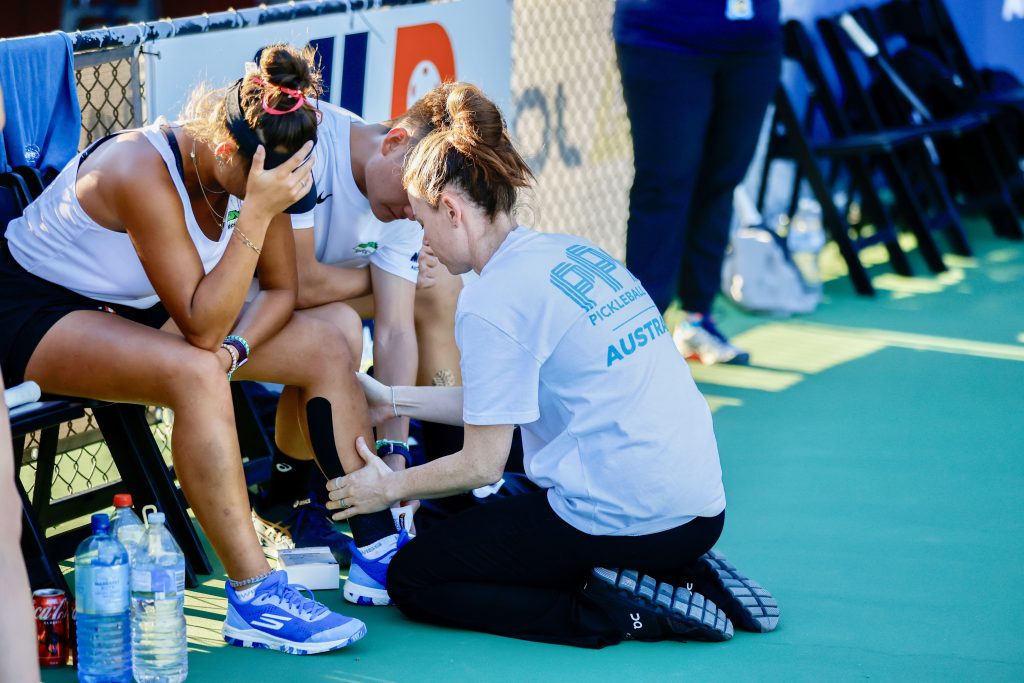
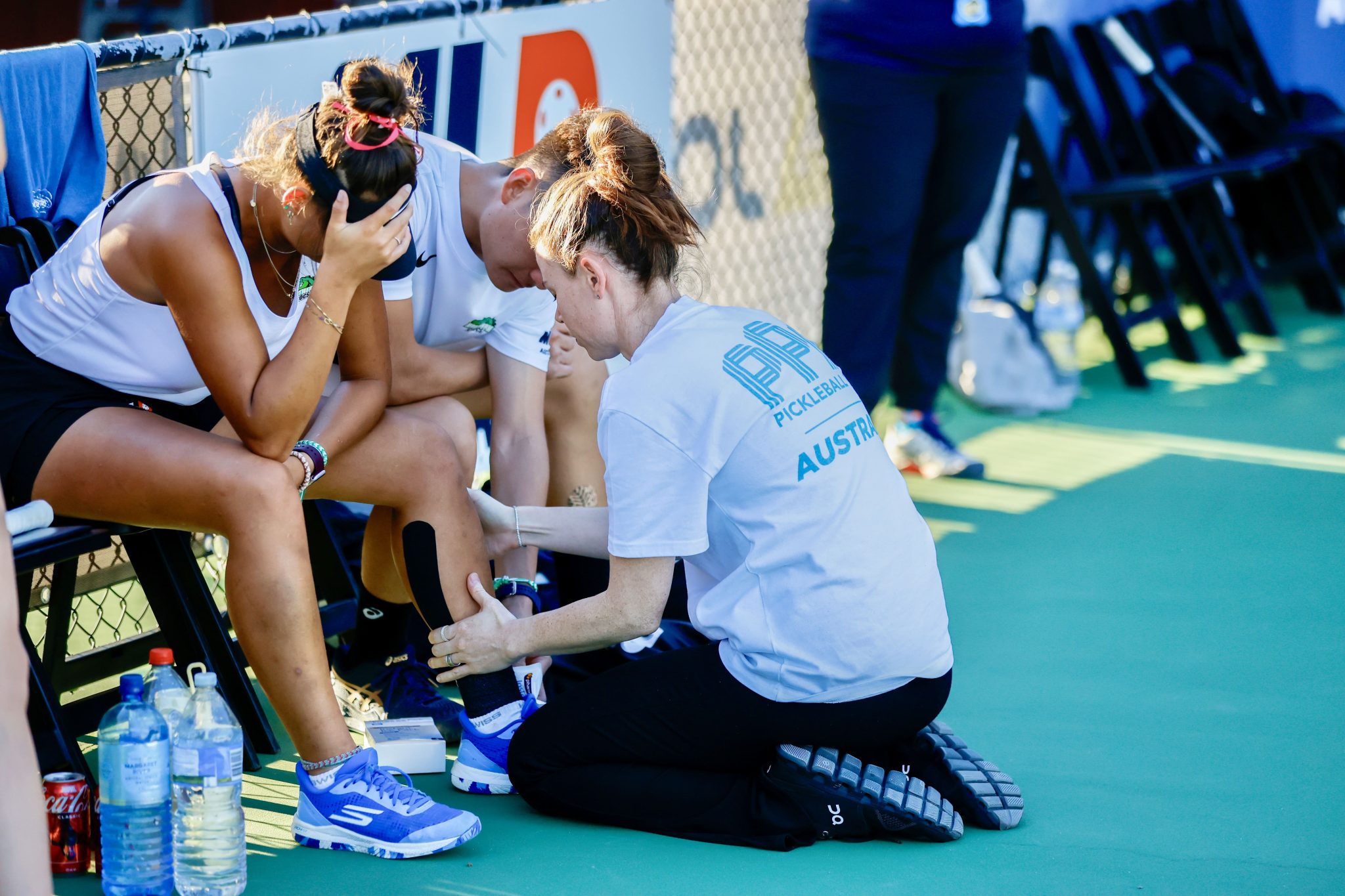
Right in this moment, a player on court called for medical, so Nat and her colleague Dr. Hayley Elmsly responded in the middle of our interview. Here’s what the mic picked up from that moment.
NS: Medical. Oh, okay.. Um, yes, pickle juice in there. Take a towel. Just take the whole bag.
TW: Run me through when there is a medical, like what just happened, what do you do? What’s your protocol for that?
NS: Well, we grab all of our stuff. So, we have two bags. One that’s a general first aid kit and one that has some tapes, creams, and band-aids. We treat it similarly to how we would if they approached us here. We go out, we ask them what’s wrong, what happened, and do some testing to figure out if it’s something we can treat so that they can play, or whether it’s something where, if they were to continue playing, it would be really bad.”
She says that, unless it’s life-threatening or a head injury, they tend not to pull a player from the game.
“We assess, make a diagnosis, and draw a conclusion. To do this, we kind of have an idea in our head of what it would look like if they continued playing. We explain, ‘This is what I think is going on. If you were to continue playing, this is what could happen.’ We either say ‘I think it’s okay to keep playing,’ or ‘I think you probably shouldn’t keep playing, but it’s up to you.’”
At the end of the day, it’s a professional recommendation they offer to players. “Most of the time, when you explain to them what you think is going to happen and suggest they don’t continue playing, even if they don’t like it, very often they agree. Most people know that it’s not worth the risk of permanent or long-term injury to stay out on the court. And we know there’s likely going to be an event in two weeks.”
“I experienced this yesterday. I told someone ‘Look, if you keep playing, this could get worse to the point where you cannot play and you might need surgery. If you stop now, we can bring it off the torch and see if we can settle it down so that tomorrow we can tape you up and you can play.’ She was upset, but she agreed. She came over, we did some stuff, and then she played again today. Sometimes they don’t like hearing it, but I also think they like having someone else make the suggestion instead of choosing for themselves. I’m happy to take on that responsibility.”
What’s in your chiro kit?
Ever wondered what the clicky things chiros have are? I was certainly curious! So I asked Nat (who gave me a very educated response).
“This one’s an activator. Essentially, it gives a small neurological input to a joint. In adjusting, if you can give the joint an impulse, whether it be through the joint capsule or a fast little stretch, you give a stimulus to the joint receptors. They send a reflex loop into your brain and back down again. That helps the soft tissue in that area. When you relax the soft tissue in a joint capsule, that joint can move better. It’s nice where manual adjusting isn’t appropriate — whether it’s sore, the person doesn’t want to be adjusted, or it’s not an appropriate treatment.”
They also have what’s called a “drop piece”, which is a part of the adjustment table that can be raised and then dropped away as pressure is applied to a joint.
“The drop piece helps us when we move the joint a little bit to get some motion in through it. It helps keep the movement small and in control for peripherals, so arms and legs. Without that, sometimes it can be less neat and tidy, and there’s more risk of it being sore. That just keeps it nice and small, so very low risk.”
Other things in her box of tools include a lot of tape. Like so many kinds of tape. Rigid tape. Underwrap. Kinesiology tape. Active tape. Dynamic tape. Elastic overwrap. There’s also band-aids, power chords??, gloves, and a special (and very fitting) jar filled with pickle juice. “I mean, research says that’s the only thing that actually works [for cramps]. Something to do with a mix of the vinegar and the salt and all of that, but how fitting, I know.”

Growing the industry as a mentor and educator
You may have also noticed some fresh faces in the player rehab zone at recent events — interns!
Nat is a huge proponent of hands-on learning, and they have now facilitated a way to get students from four major universities to the PPA events.
“In uni, students learn how to do things, not always when to do things. To come to events like this and see things being put together is super valuable. It’s something that gave me a big advantage when I was going through uni — to see things being put together. The faster these students get experience, the faster they’re going to become really effective practitioners.”
She found that, particularly during the pandemic, the sports chiropractic section of their profession took a hit with the pause of in-person events. They’re now working hard to rebuild it and find that connection again.
“Events like this are helping because [students] see what they can get to and what it all means. So far, every student who has come has said they’ve had a fabulous time. Some have driven like three hours to get here. It hasn’t been easy, but they’ve still done it.”
Another reason getting students in as early as possible is important is, “while everyone is unique and special in their own right, everyone’s also exactly the same. Bodies are the same. A lot of what we do is pattern recognition. The more you see it, the easier it is to recognise and the more targeted you can be with what you do.” While someone with 20 years of experience and another with 2 months may get to the same result, it’s all about speed and efficiency.
“I will do it faster than the student will, and my boss will do it faster than I will because he has seen it for 20 years more than I have seen it. I’ve seen it 15 years more than the students have.”
Life off the court
When she’s not caring for players at tournaments, Nat can be found balancing work in clinic and mum life in Canberra.
“In my day-to-day, I get up, get my two daughters ready for school, take them to school, and then go to work in the clinic. I only work four and a half hours a day. It’s a really nice balance. I get to do all the drop-offs and all the pick-ups, swimming, dancing… essentially turn back into normal mum.”
Nat is also incredibly dedicated to supporting the sports chiropractic space more generally.
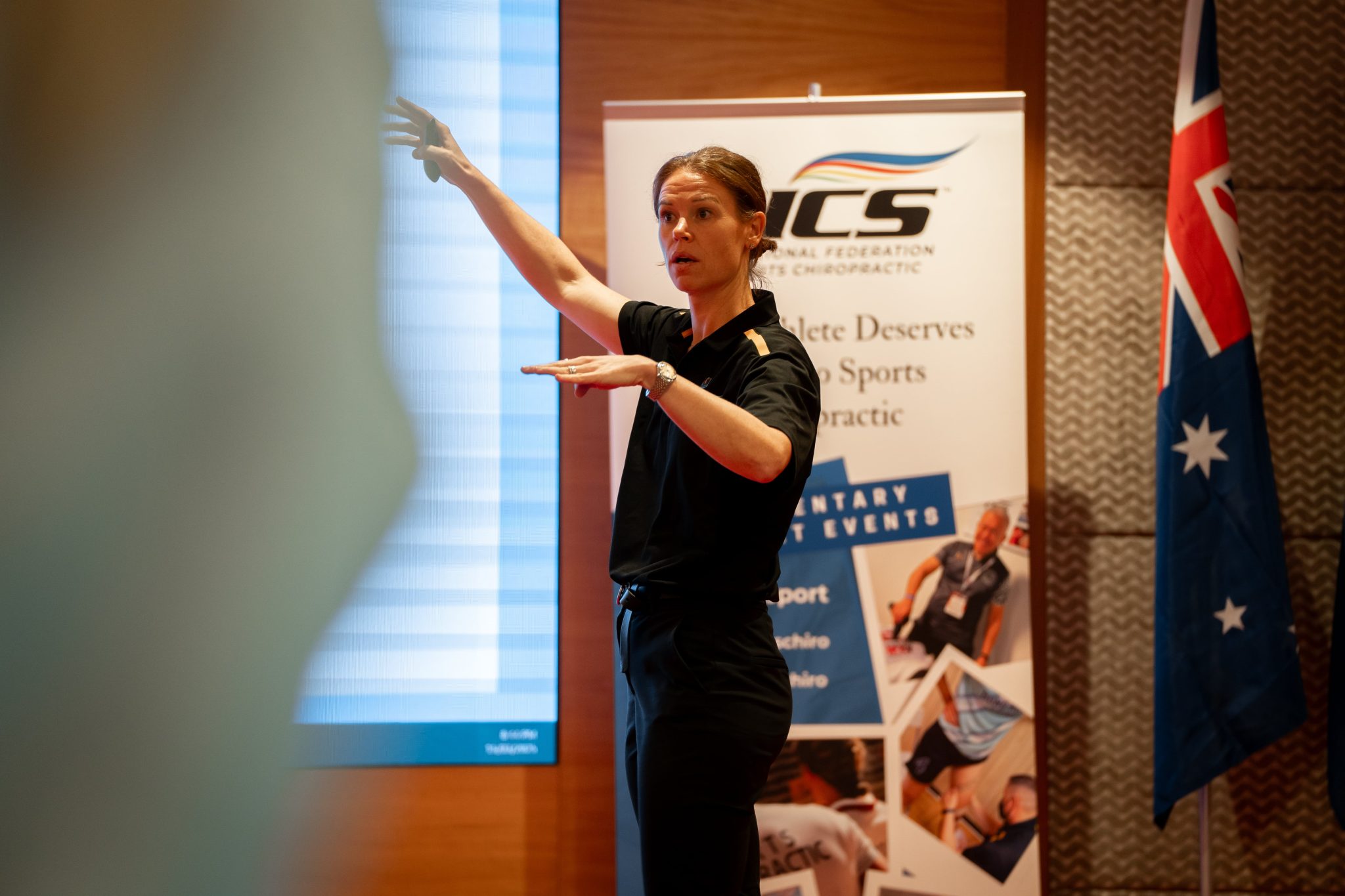
“I’m National Vice-Chair of the AICE Sports and Exercise special interest group, so I have a leadership role in the profession through that. We also have an international sports chiropractic group called the International Federation of Sports Chiropractic (FICS), and I’ve been teaching their program for the past 10 years. A week and a half ago, I was in Malaysia doing a presentation for them.”
In addition to her work with pickleball, Nat remains involved with volleyball, supporting the Australian paravolley team.
“I do a lot of stuff within the profession and the community as well, which is really nice. My goal is to open up as many opportunities for sports chiros coming through in Australia and around the world as well. I want to help students, new grads, anyone really. If there’s something here they want to do in the profession, I want to help them find that.”
Most important to Nat is making sure players always have a familiar face.
“It’s great to be people’s first choice, but you can’t be their only choice. For whatever reason, if I can no longer do this, I don’t want the relationship to die. I want it to be a smooth transition. Making sure relationships are built, maintained, and helping everyone do the things that they want to do. I had people do that for me, so now it’s my turn.”

Rapid fire questions
I’ll admit this conversation was so insightful that there’s very little I wanted to chop from the transcript. Here are a few rapid-fire questions just as good as the rest of the article.
I enjoyed Vietnam because it was a fun trip, but I hated how hot and sweaty it was. I didn’t enjoy what that led to in terms of cramping and heat stroke. I also enjoyed Melbourne at the start of the year. Having all the finals on Sunday made it a really big finish to the event. Also, any event where I get to work with Hayley.
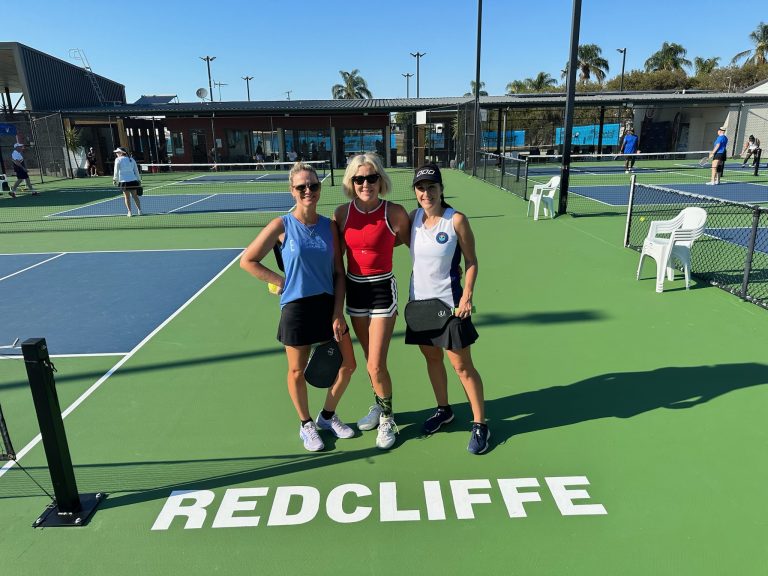
The first time I’d ever heard of pickleball, and I apologise for this, was on Vanderpump Rules. I’d never seen it in real life until the first tournament I worked, which was Redcliffe.
Some people think chiropractors put joints back in. They don’t. Joints just get tight, and we help them move better. That’s all. If it’s truly dislocated… if it’s something simple, we can help, but otherwise, you’re off to the hospital.
I’d say if they’re good, hopefully not much. Back in the day, chiros would only adjust, sort of cracking and only the spine. I don’t want to talk out of turn, but physios would essentially give exercises and that’s it. Now, I like to think everybody is reading evidence. If people are keeping up with that, all types of physical therapy are becoming more and more similar. Some people like to still hang on to what we did 100 years ago. I treat people completely differently than I did ten years ago.
The thing you believe will make the have the biggest impact. Sometimes it is telling them to go and eat something. Which happens a lot.
I think it’s experience. Sometimes it’s acting. If we can stay calm, the athlete will stay calm. If we start panicking, they start panicking. At some point, there’s only so much you can do. If you only have a few minutes, most of the time you can’t realistically fix the problem. Sometimes, all you’re doing is essentially putting a band-aid on, and they might come back to you ten minutes from now.
At a tournament, we might only have a few minutes, but we can see them six times in one day. Whereas in clinic, you see them once, but you have longer, so you can maybe do some more testing. Here, you can also see the immediate effect of what you’ve just done, as well, which is pretty rewarding. Sometimes we just do what we can do to get an immediate pain relief performance effect now.
What’s been really lovely, not so much surprising, but nice to see is how well we’ve been received. How much athletes have put their trust in us. I was just saying to the students this morning — this is their job. We can’t mess up. Which is nice for us as well to kind of have that pressure. It keeps us on our best.
You don’t only need to come for treatment if something hurts. We can do screenings and look for some things that you can then work on. But also just come and chat to us. It doesn’t even need to be treatment. Come and chat to us about what you can do in the lead up to tournaments to be in the best possible position to perform well, what to do afterwards, and what to eat. It’s not just ‘something hurts, make it feel better.’ It’s ‘What can I do to perform well?’
Prepare to be here for the whole day. Bring everything you’ll need for a whole day. Plenty of food, water and electrolytes, or, if you want, pure salt to put in it. Bring those things with you. If you know you don’t like to eat massive meals during the day, bring good snacks, something that you can eat quickly in between matches to give you good fuel.
It’s one of the things that gets overlooked, especially when you’re in the heat of the moment and it’s not readily available. Not everybody has a fabulous wife following you around, feeding everyone cookies and making sure you’re fed. These guys are professional athletes and know that’s a part of it. Looking after yourself off the court is important. In other professional sports, you have a team that does that for you. You don’t really have that here in pickleball yet. You have to do it for yourself.
Where to find Nat [Canberra locals]
If you’re lucky enough to live in Canberra, you can find Dr. Nat Sharp at Enhance Healthcare in Mitchell. You can also find her on socials @natfrosty.
Tati’s thoughts
The people of pickle segment is my absolute favourite part of the blog. In a sport with so many moving parts, people like Nat remind us that the heart of sport is always human. Nat and her team’s work is proof that success is built off the court just as much as on it.
And personally, I’m so appreciative of the work Nat, Hayley and the rest of the team do at each tournament to help all of the athletes perform at their best. While you typically won’t find me on the court, I got to see their incredible work firsthand during a scary moment in Vietnam when Joey’s dominant wrist suddenly stopped responding just before his mixed doubles finals match.
As soon as he started playing, I could immediately see something was off as he kept grabbing at and twisting his wrist. During a medical timeout, Nat and Hayley were able to offer him some immediate relief, using techniques in exactly the right places to get a bit of mobility back for him. As Nat explains above, they can’t always offer a solution, but sometimes even that temporary help is enough to get through a match.
He went on to play for about two hours, using up every time-out possible and running to the rehab zone for every second he had. Along with Danni’s support, they took home the gold that afternoon.
Thank you, Nat, Hayley & co for the incredible work you do!!
People of Pickle is our way of spotlighting the incredible humans shaping the game in Australia and beyond, and we’d love your help.
👉 Know someone doing amazing things in the world of pickleball? DM me or leave a comment below. We’re always on the lookout for the next inspiring story to tell!